The relentless summer heat often makes an air conditioner feel less like a luxury and more like a necessity. While this invaluable appliance provides much-needed comfort, it can also send your electricity bills soaring. Understanding how much electricity your air conditioner uses is the first step toward gaining control over your energy costs and making informed decisions about your home’s cooling system. This comprehensive guide will demystify AC power consumption, explore the myriad factors that influence its usage, and equip you with expert strategies to significantly reduce your energy footprint and save money.
Understanding Air Conditioner Electricity Consumption
At its core, an air conditioner consumes electricity to move heat from inside your home to the outside, effectively cooling your living space. This energy usage is typically measured in watts (W) at any given moment and in kilowatt-hours (kWh) over time, which is what you see on your electricity bill. On average, cooling an American home requires approximately 2,365 kWh of electricity annually, accounting for roughly 12% of a typical household’s total energy use. This figure, however, is a broad average, with actual consumption varying dramatically based on numerous factors.
To calculate your air conditioner’s energy cost, you need to know its wattage, how many hours it runs, and your local electricity rate. The formula is straightforward: Multiply the AC’s wattage by the hours it runs per day, then divide by 1,000 to get daily kWh. For instance, a 1,500-watt unit running for eight hours consumes 12 kWh daily. Multiply this by your electricity rate per kWh to find the daily cost, and then by the number of cooling days to estimate your monthly or seasonal expenses.
Key Factors Influencing AC Power Usage
The amount of electricity an air conditioner consumes is not static; it’s a dynamic interplay of several crucial elements. From the design of your unit to your local climate and personal habits, each factor contributes to the final number on your energy bill.
Air Conditioner Type and Size
The type and size of your air conditioner are fundamental determinants of its electricity usage. Different systems are designed for varying cooling capacities and operational efficiencies.
- Central Air Conditioners: These powerful systems cool an entire home through a network of ducts. They typically consume the most electricity, with units ranging from 1,000 to 5,000 watts per hour. A small central AC (1-2 tons) might use 2,000-3,000 watts hourly, while larger systems (4-5 tons) can draw up to 5,000 watts per hour.
- Window Units: Designed for single rooms, window air conditioners are generally more energy-efficient for localized cooling. Their hourly consumption ranges from 500 to 1,440 watts. Small window units (5,000-8,000 BTU) may use 500-900 watts, while larger ones (12,000-18,000 BTU) can draw 1,200-1,440 watts.
- Portable ACs: Offering flexibility for renters or occasional use, portable air conditioners can be less efficient than window units. They often consume between 2,900 and 4,100 watts per hour, with some sources reporting consumption between 1.2 to 2.8 kWh per hour.
- Mini-Split and Ductless Systems: These are often considered efficiency champions, providing targeted cooling for specific zones without the energy loss associated with ductwork. They typically use 700 to 2,000 watts per hour, depending on capacity, and can be up to 30% more efficient than central air systems.
- Split-System Units: Common in many homes, these units typically use between 0.8 to 2.5 kWh per hour, depending on their cooling capacity (e.g., a 1.5 kW unit uses approximately 1.5 kWh/hour, while a 3.5 kW unit can consume around 3.5 kWh/hour).
|
Our Picks for the Best Air Conditioner in 2026
As an Amazon Associate I earn from qualifying purchases.
|
||
| Num | Product | Action |
|---|---|---|
| 1 | BLACK+DECKER Window Air Conditioner 10000 BTU, AC Window Unit Cools Up to 450 Square Feet, Window AC Unit with Remote Control, 3 Cooling Speeds and Fan Only Function, BD10WT6, White |

|
| 2 | 24" Windowless Portable Air Conditioner, 15H Timer & 120°Oscillation, 3-IN-1 Portable AC Unit with Remote, 2-Gal Tank, 3 Modes & 3 Speeds, Ultra-Quiet Ventless Swamp Cooler for Home Office, Off |
|
| 3 | Portable Air Conditioners, 3-IN-1 Swamp Cooler, Evaporative Air Cooler,Remote & Touch Control, 90°+90° Oscillation,LED Screen, Air Coolong Fan for Outdoor Indoor |
|
| 4 | Windowless Portable Air Conditioners with Remote, Ventless Ac Unit Ductless Air Cooler,Hoseless Quiet Evaporative Oscillating Swamp Cooler,12H Timer & 4 Ice Box for Room Indoor Outdoor Office Bedroom |
|
| 5 | SereneLife Portable Swamp Cooler Air Conditioner - 2500 CFM Airflow, 8 Gallon Water Tank Portable Evaporative Air Cooler for Room & Outdoors, WiFi, Humidifier & Fan Modes, Ice Packs & Remote Included |
|
| 6 | Evaporative Air Cooler with Remote & Timer, 2200+ CFM Portable Fan That Blows Cold Air for Large Room, Home Office, Bedroom - 2.1Gal High-Capacity Tank, 3 Modes, Whisper Quiet 30dB & Sleep Mode |
|
| 7 | Dreo Tower Fan for Bedroom, 42 Inch 120° Oscillating Fan, 25dB Quiet DC Motor, 28ft/s Velocity Bladeless Standing Fan with 12 Speeds, 4 Modes, 12H Timer Cooling Fans for Home, Living Room |
|
| 8 | Midea 5,000 BTU EasyCool Small Window Air Conditioner - Cool up to 150 Sq. Ft. with Easy-to-Use Mechanical Controls and Reusable Filter, Perfect for Small Bedroom, Living Room, Home Office |
|
| 9 | Windowless Portable Air Conditioner, 24.4" Small Evaporative Air Cooler for Room No Window, 3-Speed Settings, 4 Modes, 7H Timer, Remote Control, 4 Ice Packs, Quiet AC Unit for Bedroom, White |
|
| 10 | Dreo Tower Fan for Bedroom, 2026 Upgraded DC Motor, 28ft/s High Velocity, 20dB Ultra Quiet Standing Fan, 8 Speeds 4 Modes, 90° Oscillating Bladeless Fan for Indoors, Floor Fans with Remote, Black |
|
Energy Efficiency Ratings (SEER/SEER2)
The Seasonal Energy Efficiency Ratio (SEER) or its updated version, SEER2, is a critical metric for understanding an air conditioner’s efficiency. These ratings measure the cooling output over a typical cooling season divided by the total electric energy input during the same period. A higher SEER or SEER2 rating indicates a more efficient air conditioner, meaning it can provide the same amount of cooling using less electricity. For instance, upgrading an older 10 SEER unit to a modern 16 SEER2 system can slash cooling costs by over 40%, translating to significant annual savings. Each point increase in the SEER rating can reduce energy consumption by approximately 7%.
Climate and Environmental Conditions
Your local climate plays a substantial role in how hard your air conditioner has to work. Warmer temperatures and higher humidity levels force the unit to operate more intensely and for longer durations, directly increasing electricity consumption. A home in a scorching, humid region will naturally use far more energy for cooling than one in a milder climate. Furthermore, your home’s insulation quality is paramount. A well-insulated house retains cool air more effectively, reducing the AC’s workload, while poor insulation allows heat to seep in, forcing the system to run almost continuously.
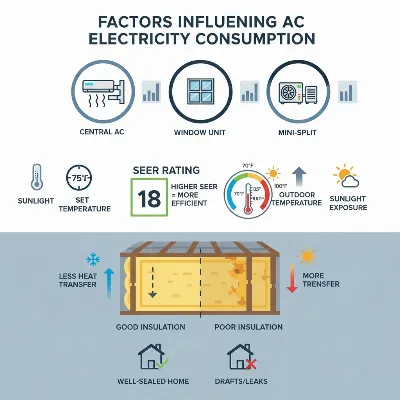 Factors affecting air conditioner electricity usage: unit type, SEER rating, weather, and home insulation
Thermostat Settings and Usage Habits
The temperature you set on your thermostat has an exponential impact on energy use. Each degree you lower the thermostat can increase energy consumption by 6-8%. Setting your AC to a comfortable yet slightly warmer temperature, such as 75-78°F (24-26°C), is widely recommended for balancing comfort with efficiency. Beyond just the setting, your usage patterns—how often and how long you run the unit daily—are critical. Continuous operation will obviously consume more electricity than strategic use.
System Age and Maintenance
An air conditioner’s age and how well it’s maintained significantly affect its efficiency. Older units, especially those more than 10 years old, typically have lower SEER ratings and can become less efficient over time due to wear and tear. Regular maintenance, such as cleaning or replacing air filters, is essential. Dirty or clogged filters restrict airflow, forcing the AC to work harder and reducing its efficiency by 5-15%. Neglecting maintenance can lead to reduced performance, increased energy use, and even costly breakdowns.
Pro Tips for Reducing Air Conditioner Electricity Bills
Taking proactive steps to manage your air conditioner’s electricity consumption can lead to substantial savings on your energy bills. Here are expert-backed strategies to keep your home cool without breaking the bank.
Smart Thermostat Strategies
Investing in a programmable or smart thermostat is one of the most effective ways to optimize your AC’s performance. These devices allow for precise temperature control and the creation of cooling schedules that align with your daily routine. You can program your air conditioner to run less when you’re away from home or sleeping, and then ramp up cooling just before you return or wake up. Many smart thermostats also offer remote access via smartphone apps and geo-fencing features, learning your habits and adjusting temperatures automatically as you enter or leave your home.
Regular Maintenance Essentials
Consistent maintenance is crucial for your air conditioner’s longevity and efficiency. The simplest yet most impactful task is regularly cleaning or replacing your air filters, ideally every 1 to 3 months, or more frequently if you have pets or allergies. A clean filter ensures optimal airflow, allowing your unit to cool more effectively with less energy. Additionally, scheduling annual professional maintenance checks can keep your system in top condition. Technicians can inspect refrigerant levels, clean coils, and check electrical connections, preventing minor issues from escalating into major, energy-wasting problems.
> “Many homeowners overlook the importance of a clean air filter, but it’s often the quickest and cheapest way to improve your AC’s efficiency by 5 to 15%. It’s like asking your lungs to breathe through a clogged mask; your AC has to work much harder.” – John Peterson, HVAC Certified Technician
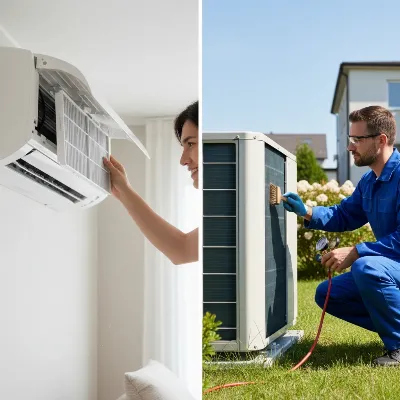 Air conditioner maintenance for energy efficiency with clean filters and professional check-ups
Optimizing Home for Cooling Efficiency
Your home itself plays a significant role in how efficiently your air conditioner operates. Improve your home’s thermal envelope by sealing any leaks around windows and doors with weatherstripping or caulk. Using blackout curtains or blinds on windows, especially those facing south or west, can prevent direct sunlight from heating your home, reducing the cooling load on your AC. Additionally, close vents and doors in unused rooms to direct cool air only to occupied spaces, preventing wasted energy.
Smart Usage Habits
Beyond technological solutions and maintenance, your daily habits can greatly influence your AC’s electricity usage.
- Optimal Temperature Settings: Aim to set your thermostat between 75-78°F (24-26°C) during the day. Raising the temperature by even a few degrees can noticeably reduce energy consumption.
- Utilize Fans: Ceiling fans can make a room feel 4-7°F cooler, allowing you to raise your thermostat setting without sacrificing comfort. Since fans use significantly less electricity than an AC, using them in conjunction with your air conditioner is a smart strategy.
- Avoid Heat-Generating Appliances: Try to use heat-producing appliances like ovens, dryers, and dishwashers during cooler parts of the day or evening to minimize indoor heat buildup.
- Turn Off When Away: If you’re leaving your home for several hours, it’s generally more energy-efficient to turn off your air conditioner or set it to a higher temperature than to let it run continuously to maintain a low temperature.
Comparative Table: AC Type & Estimated Hourly Wattage
This table provides a general overview of the estimated hourly wattage for common air conditioner types. Actual consumption will vary based on efficiency, size, and operational conditions.
| Air Conditioner Type | Estimated Hourly Wattage Range | Notes |
|---|---|---|
| Central Air Conditioner | 1,000 – 5,000 W | Varies significantly by tonnage (size of home) |
| Window Unit (Small-Large) | 500 – 1,440 W | Efficient for single rooms; varies by BTU |
| Portable AC | 1,200 – 4,100 W | Less efficient; high wattage for flexibility |
| Mini-Split/Ductless | 700 – 2,000 W | Highly efficient, zoned cooling |
| Split-System Unit | 800 – 3,500 W | Common household AC; varies by kW capacity |
Expert Insights on AC Efficiency
> “The biggest mistake homeowners make is treating their air conditioner as a set-and-forget appliance. Understanding its efficiency rating and committing to simple, regular maintenance can often reduce your cooling costs by 20-30% without sacrificing comfort. It’s about being smart with your cool.” – Sarah Chen, Energy Efficiency Consultant
Conclusion
Understanding how much electricity your air conditioner uses is vital for managing your home energy budget. From the type and size of your unit to external climate conditions and your daily habits, numerous factors converge to determine your cooling costs. By embracing energy-efficient practices, such as utilizing smart thermostats, performing regular maintenance, optimizing your home’s insulation, and adopting smart usage habits, you can significantly reduce your electricity consumption. Taking control of your air conditioner’s energy use not only leads to substantial savings on your utility bills but also contributes to a more sustainable lifestyle. How will you begin optimizing your air conditioner for ultimate energy efficiency this season?
Câu Hỏi Thường Gặp
How much electricity does a 1-ton Air Conditioner use per hour?
A 1-ton (12,000 BTU) central air conditioner typically uses around 1,000 to 1,500 watts per hour. However, this can fluctuate based on the unit’s Seasonal Energy Efficiency Ratio (SEER) rating, the outdoor temperature, and how well your home is insulated. More efficient units will draw less power.
Is it cheaper to leave the Air Conditioner on all day or turn it off?
Generally, it is more energy-efficient to turn off your air conditioner when you are away from home for several hours. While the unit will work harder to cool down upon your return, this initial effort is usually less than the continuous energy drain of maintaining a low temperature throughout the day in an empty house.
What is a good energy-efficient temperature for an Air Conditioner?
For optimal energy efficiency and comfort, it is recommended to set your air conditioner between 75°F and 78°F (24°C to 26°C). Raising your thermostat by even one or two degrees can result in noticeable energy savings, typically reducing consumption by 6-8% per degree.
