Few things disrupt a comfortable home faster than an air conditioner that suddenly stops working, especially on a sweltering day. When your AC unit trips its circuit breaker, it can feel like a major problem, but often, a simple DIY reset can resolve the issue and restore cool air. This comprehensive guide will walk you through the safe, step-by-step process of resetting your air conditioner, help you understand why it might have tripped in the first place, and equip you with essential troubleshooting tips to prevent future outages.
An Overview of Your Air Conditioner’s Safety Mechanisms
Your air conditioner is equipped with built-in safety features designed to protect the unit from damage and prevent electrical hazards. The most crucial of these is the circuit breaker. When the AC system draws too much electrical current—perhaps due to an electrical overload, a short circuit, or a mechanical problem—the circuit breaker acts as a guardian, automatically “tripping” to cut off power. This immediate shutdown prevents overheating, potential fires, and costly damage to your AC unit’s internal components. Understanding that a tripped breaker is often a symptom, not the root cause, is the first step toward effective troubleshooting and a quick resolution.
Historically, early air conditioning units lacked many of the sophisticated safety controls found today. Modern systems integrate advanced sensors and protective relays that work in conjunction with your home’s electrical panel to ensure safe operation. These mechanisms are vital for extending the lifespan of your cooling system and safeguarding your home. Recognizing the role of these safety features can demystify why your air conditioner might suddenly cease to function, paving the way for a safe and informed DIY reset.
Step-by-Step Guide to Safely Resetting a Tripped Air Conditioner
When your air conditioner trips, performing a quick reset can often bring your system back online. However, safety is paramount during this process to prevent electrical shock or further damage to your unit. Always approach electrical components with caution and ensure you follow each step meticulously.
Safety First: Essential Precautions Before You Begin
|
Our Picks for the Best Air Conditioner in 2026
As an Amazon Associate I earn from qualifying purchases.
|
||
| Num | Product | Action |
|---|---|---|
| 1 | Windowless Portable Air Conditioners with Remote, Ventless Ac Unit Ductless Air Cooler,Hoseless Quiet Evaporative Oscillating Swamp Cooler,12H Timer & 4 Ice Box for Room Indoor Outdoor Office Bedroom |

|
| 2 | Midea 5,000 BTU EasyCool Small Window Air Conditioner - Cool up to 150 Sq. Ft. with Easy-to-Use Mechanical Controls and Reusable Filter, Perfect for Small Bedroom, Living Room, Home Office |
|
| 3 | Portable Air Conditioners, 3-IN-1 Swamp Cooler, Evaporative Air Cooler,Remote & Touch Control, 90°+90° Oscillation,LED Screen, Air Coolong Fan for Outdoor Indoor |
|
| 4 | BLACK+DECKER Window Air Conditioner 10000 BTU, AC Window Unit Cools Up to 450 Square Feet, Window AC Unit with Remote Control, 3 Cooling Speeds and Fan Only Function, BD10WT6, White |
|
| 5 | Windowless Portable Air Conditioner, 24.4" Small Evaporative Air Cooler for Room No Window, 3-Speed Settings, 4 Modes, 7H Timer, Remote Control, 4 Ice Packs, Quiet AC Unit for Bedroom, White |
|
| 6 | Dreo Tower Fan for Bedroom, 42 Inch 120° Oscillating Fan, 25dB Quiet DC Motor, 28ft/s Velocity Bladeless Standing Fan with 12 Speeds, 4 Modes, 12H Timer Cooling Fans for Home, Living Room |
|
| 7 | 24" Windowless Portable Air Conditioner, 15H Timer & 120°Oscillation, 3-IN-1 Portable AC Unit with Remote, 2-Gal Tank, 3 Modes & 3 Speeds, Ultra-Quiet Ventless Swamp Cooler for Home Office, Off |
|
| 8 | Dreo Tower Fan for Bedroom, 2026 Upgraded DC Motor, 28ft/s High Velocity, 20dB Ultra Quiet Standing Fan, 8 Speeds 4 Modes, 90° Oscillating Bladeless Fan for Indoors, Floor Fans with Remote, Black |
|
| 9 | Evaporative Air Cooler with Remote & Timer, 2200+ CFM Portable Fan That Blows Cold Air for Large Room, Home Office, Bedroom - 2.1Gal High-Capacity Tank, 3 Modes, Whisper Quiet 30dB & Sleep Mode |
|
| 10 | SereneLife Portable Swamp Cooler Air Conditioner - 2500 CFM Airflow, 8 Gallon Water Tank Portable Evaporative Air Cooler for Room & Outdoors, WiFi, Humidifier & Fan Modes, Ice Packs & Remote Included |
|
Before you touch any part of your air conditioning system or electrical panel, prioritize your safety. Electrical currents can be dangerous, and taking the necessary precautions protects both you and your equipment. Always ensure your hands are dry, and stand on a dry, non-conductive surface.
First, turn off your thermostat completely. Switch it to the “Off” position to prevent the AC from trying to cycle on prematurely. Next, locate your home’s main electrical panel, typically found in a garage, basement, utility closet, or outside. Before opening the panel or touching any breakers, take a moment to visually inspect the area around the panel and your outdoor AC unit for any obvious signs of damage, such as frayed wires, burn marks, or unusual odors. If you notice any of these, do not proceed; instead, contact a qualified electrician immediately.
> “Safety is not just a procedure; it’s a mindset, especially when dealing with electricity. Always double-check your power sources before attempting any DIY repair.” – Mark Jenkins, Certified HVAC Technician
Locating and Resetting the Circuit Breaker
The circuit breaker is your primary point of control for safely cutting power to the air conditioner. You’ll need to locate the specific breaker dedicated to your AC unit within your home’s main electrical panel. These breakers are often labeled “AC,” “Furnace,” “HVAC,” or by a specific amperage, such as “30A” or “40A,” especially for larger, 240-volt units.
Once identified, you’ll likely find the breaker in one of three positions: “On,” “Off,” or a middle “Tripped” position. If it’s in the tripped position, it will be slightly dislodged from the “On” side. To reset it, firmly push the breaker all the way to the “Off” position first, then immediately flip it back to the “On” position. This two-step motion ensures a complete reset. If the breaker does not stay in the “On” position or immediately trips again, this is a strong indication of a persistent electrical problem that requires professional attention. After resetting the breaker, wait a minimum of 5 to 10 minutes before proceeding to the next step, allowing the system’s internal components and electrical pressure to equalize.
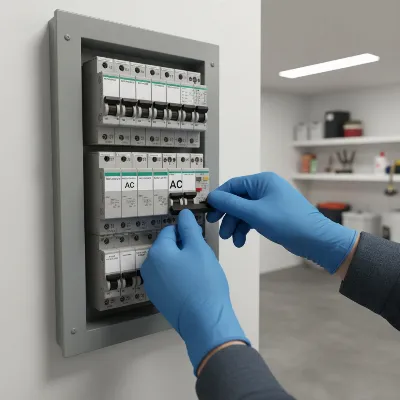 Hands turning off a main electrical panel circuit breaker for an air conditioner unit
Checking the AC Unit’s Internal Reset Button (If Applicable)
Many modern air conditioning units, particularly central air models, have an additional internal reset button on the outdoor condenser unit. This button provides an extra layer of protection, allowing you to reset the unit directly if a minor fault occurs without affecting other circuits in your home. However, not all AC units are equipped with this feature, and its location can vary.
Typically, this reset button is small, red or yellow, and can be found near the compressor or within the outdoor unit’s access panel. You might need a screwdriver to remove a service panel cover to expose it. If your unit has this button, press and hold it firmly for approximately 3 to 5 seconds, then release. You might hear a faint click, signaling the reset. If you’re unsure whether your unit has one or where it’s located, consult your air conditioner’s owner’s manual for precise instructions. If you don’t find a reset button, don’t worry—the circuit breaker reset is often sufficient. After engaging the internal reset, wait another 5 minutes before restarting your thermostat to give the system time to stabilize.
What to Do If the Breaker Trips Immediately Again
If your circuit breaker trips again immediately after you reset it, or within a very short period (e.g., a few minutes), this is a critical warning sign. It indicates a more serious underlying issue within your air conditioner or your home’s electrical system that cannot be resolved by a simple reset. Attempting to repeatedly reset a breaker that continuously trips can cause further damage to your AC unit, lead to overheating of electrical components, or even pose a fire hazard.
In this scenario, it is crucial to switch the AC circuit breaker to the “Off” position and leave it there. Do not attempt further resets or DIY repairs. This situation almost always warrants the expertise of a qualified HVAC technician or a licensed electrician. They have the specialized tools and diagnostic knowledge to identify and safely repair complex electrical faults, compressor issues, or other mechanical failures that are causing the recurring trips.
Common Reasons Your Air Conditioner Trips and How to Prevent Them
A tripping circuit breaker is your air conditioner’s way of telling you something is wrong. Understanding the common culprits can help you address issues proactively and potentially prevent future system shutdowns.
Overloaded Circuits
An overloaded circuit occurs when the electrical demand on a specific circuit exceeds its capacity, causing the breaker to trip as a protective measure. For an air conditioner, this can happen if the unit itself is drawing more current than usual. This might be due to an aging compressor that struggles to start, a failing fan motor, or a capacitor that’s no longer providing adequate power assistance. Sometimes, a circuit might be overloaded if too many high-power appliances are connected to the same electrical line as your AC, though dedicated AC circuits are standard practice to mitigate this.
To prevent overloads, ensure your AC unit is on a dedicated circuit as per electrical codes. If you have an older home, it might be worth having an electrician verify your electrical panel’s capacity and wiring. Regular maintenance can also identify components like capacitors that are nearing failure, allowing for replacement before they cause an overload.
Dirty Air Filters and Coils
Perhaps the most common and easily preventable cause of an AC tripping is dirty air filters or condenser coils. When an air filter becomes clogged with dust, pet dander, and other debris, it severely restricts airflow through the system. This forces the blower motor to work much harder to pull air, increasing its electrical draw and potentially leading to an overloaded circuit. Similarly, dirty condenser coils on your outdoor unit cannot efficiently release the heat absorbed from your home. This causes the entire system, especially the compressor, to overheat, leading to increased power consumption and ultimately tripping the breaker as a safety measure.
Prevention: Regularly inspect and replace your air filters, typically every 1 to 3 months, or more frequently if you have pets or allergies. For condenser coils, ensure the outdoor unit is clear of vegetation, dirt, and debris. Periodically rinse the coils gently with a garden hose (with power to the unit completely off) to keep them clean.
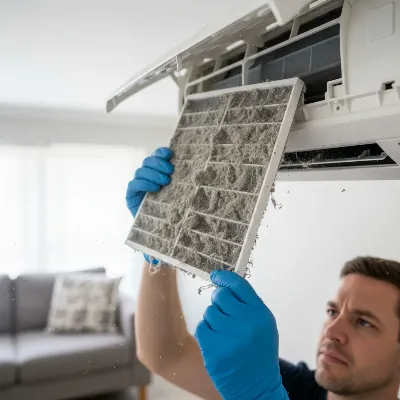 Person cleaning a dirty air conditioner filter and outdoor condenser coils
Electrical Issues: Wiring and Capacitors
Beyond simple overloads, specific electrical faults within the AC unit itself can cause a breaker to trip. Loose, corroded, or damaged wiring can create resistance, leading to overheating or short circuits. Over time, insulation on wires can degrade, exposing conductive material and causing electrical arcing. Furthermore, capacitors, which are vital components that provide a burst of electricity to start motors (fan and compressor), can weaken or fail. A failing capacitor might cause the motor to struggle to start or run, drawing excessive current and tripping the breaker.
Prevention: Electrical components within an AC system should only be inspected and repaired by a qualified HVAC technician or electrician. During routine maintenance, professionals can check wiring, test capacitors, and address any potential electrical weaknesses before they become major problems. If you suspect an electrical issue, always err on the side of caution and call an expert.
Low Refrigerant Levels and Frozen Coils
Refrigerant is the substance that absorbs heat from your indoor air and releases it outside. If your air conditioner has a refrigerant leak, the system’s ability to cool effectively is severely compromised. Low refrigerant levels cause the AC to work much harder to achieve the desired temperature, placing immense strain on the compressor and other components. This increased effort translates to higher electrical draw, which can trip the circuit breaker.
Paradoxically, low refrigerant can also lead to the evaporator coils (the indoor coils) freezing over. This happens because insufficient refrigerant causes a drop in pressure and temperature within the coils, dropping them below freezing point. A layer of ice acts as an insulator, blocking airflow and making the unit work even harder, often resulting in a tripped breaker.
Prevention: Refrigerant leaks require professional diagnosis and repair. If you notice ice on your coils or suspect a leak (e.g., hissing sounds, warm air from vents), turn off your AC and call an HVAC technician. Regular professional maintenance includes checking refrigerant levels and inspecting for leaks.
Motor Problems (Fan/Compressor)
Your air conditioner relies on several motors to operate: the blower motor (indoor unit) and the condenser fan motor and compressor motor (outdoor unit). If any of these motors start to fail, they can draw excessive current and cause the breaker to trip. A failing motor might struggle to start, hum loudly, or seize entirely. For example, a condenser fan motor that isn’t spinning freely due to debris or worn bearings can overheat the outdoor unit. Similarly, a compressor, which is the heart of your AC system, if it’s struggling to pump refrigerant, will demand more electricity, leading to a trip.
Prevention: Listen for unusual noises from your AC unit, such as grinding, squealing, or persistent humming. These can be early indicators of motor problems. Ensure the outdoor unit’s fan blades are clear of obstructions. Regular professional tune-ups include inspecting and lubricating motors and checking their electrical draw, identifying potential failures before they lead to a complete breakdown.
Buying Guide: Experience from an Air Conditioner Specialist
Choosing the right air conditioner involves more than just picking a brand; it requires understanding your specific needs and the technology available. With over a decade of experience in the air conditioning field, I’ve seen countless homeowners make both wise and regrettable decisions. Here’s what I’ve learned about navigating the market.
Economic Advantages: Maximizing Value Over Time
Many consumers focus solely on the initial purchase price of an air conditioner, but the true cost lies in its long-term operational efficiency. An AC unit with a higher Seasonal Energy Efficiency Ratio (SEER) or Energy Efficiency Ratio (EER) rating might have a slightly higher upfront cost, but the energy savings over its lifespan can be substantial. For instance, upgrading from an old 8 SEER unit to a new 15 SEER unit can cut your cooling costs almost in half. This is especially critical in regions with extended cooling seasons, where a few percentage points in efficiency can translate to hundreds of dollars saved annually. Consider the climate you live in, the average summer temperatures, and how frequently you anticipate using your AC. A specialist can help you calculate the payback period for a more efficient model, illustrating how the initial investment quickly recoups itself through lower utility bills.
> “Investing in a high-efficiency air conditioner is less about the initial sticker price and more about the long-term savings on your energy bills. It’s a wise decision that pays dividends over the lifespan of the unit.” – Alex Chen, Lead HVAC Engineer
Innovations in Air Quality: Beyond Just Cooling
Modern air conditioners are no longer just about temperature control; they play a significant role in indoor air quality (IAQ). With growing concerns about allergens, pollutants, and airborne pathogens, manufacturers have integrated advanced filtration and purification technologies. Look for units that offer multi-stage filtration systems, including HEPA filters, activated carbon filters, or even UV-C light purifiers. These features are particularly beneficial for households with allergy sufferers, asthma patients, or those sensitive to environmental contaminants. Some high-end models even incorporate ionizers or plasma generators that actively neutralize airborne particles and odors. While these features add to the unit’s cost, they provide a healthier living environment, which for many, is an invaluable benefit. When discussing options with a salesperson, ask specifically about IAQ features and how they integrate into the overall system design.
Customization and Smart Home Integration: Tailored Comfort
The evolution of smart home technology has profoundly impacted air conditioning systems. Today’s AC units can be seamlessly integrated into your smart home ecosystem, offering unparalleled convenience and control. Features like Wi-Fi connectivity, geo-fencing, and voice assistant compatibility allow you to manage your home’s climate from anywhere using a smartphone or tablet. Smart thermostats learn your preferences and optimize cooling schedules, further enhancing energy efficiency. Zoned cooling systems, which allow you to set different temperatures in various parts of your home, are another excellent customization option. This prevents overcooling unused rooms and ensures comfort where it’s needed most. When choosing an air conditioner, consider how it will fit into your existing or planned smart home setup. Look for open-source compatibility or popular smart home platforms to ensure smooth integration.
Material and Build Quality: The Foundation of Longevity
The durability and longevity of an air conditioner are heavily influenced by the quality of its materials and construction. While some manufacturers might cut corners to reduce costs, premium brands often use robust components, corrosion-resistant coatings, and superior insulation. For instance, units with all-aluminum coils tend to be more resistant to formicary corrosion compared to older copper coils. High-quality fan motors, robust compressors, and well-sealed cabinets contribute to quieter operation and a longer service life. Examining warranty periods and reading independent reviews can provide insights into a unit’s build quality. Remember, a cheaper unit that fails after five years costs more in the long run than a slightly pricier, well-built unit that lasts fifteen. Pay attention to the gauge of the sheet metal, the quality of the internal wiring, and the overall fit and finish. These details often reveal the manufacturer’s commitment to durability.
Table Comparing Common AC Tripping Scenarios and Solutions
| Symptom / Scenario | Most Likely Cause(s) | DIY Solution / Prevention | When to Call a Professional |
|---|---|---|---|
| Breaker trips, AC not cooling | Overload, dirty filter/coils, minor electrical glitch | Reset breaker, clean filter/coils | Breaker trips immediately again, persistent tripping |
| AC runs, but blows warm air, then trips | Low refrigerant, frozen coils, failing compressor | Turn off AC to thaw coils (if frozen) | Suspected refrigerant leak, AC blows warm after thawing |
| AC hums loudly but doesn’t start, then trips | Failing capacitor, stuck fan motor | Check for debris blocking fan (power off!) | Persistent hum/no start, visible motor damage |
| AC trips during heavy use/hot weather | Overheating due to dirty coils, undersized unit | Clean condenser coils, ensure proper airflow | AC frequently struggles in high heat, consistently trips |
| Burning smell, flickering lights | Electrical short, loose wiring, motor overheating | Immediately turn off power at breaker, do not reset | Always call an electrician/HVAC technician immediately |
| Water leaks from indoor unit, then AC trips | Frozen evaporator coil, clogged condensate drain | Turn off AC to thaw, clear drain line | Recurring leaks, persistent freezing, poor cooling |
Expert Tips for Maintaining Your Air Conditioner and Preventing Future Trips
Regular maintenance is the cornerstone of a reliable and efficient air conditioning system. As an experienced technician, I’ve seen firsthand how a little preventative care can save homeowners significant money and hassle.
The Power of Routine Filter Replacement
The air filter is your AC’s first line of defense against dust and debris. A clean filter allows for optimal airflow, which is crucial for the system to operate efficiently and prevent strain on its components. When a filter becomes clogged, your AC has to work harder to pull air through, leading to increased energy consumption and a higher risk of tripping the circuit breaker.
Expert Tip: Make filter replacement a seasonal or monthly habit. For most homes, replacing standard 1-inch filters every 1 to 3 months is sufficient. If you have pets, allergies, or live in a dusty environment, check and replace them monthly. Upgrading to a higher MERV (Minimum Efficiency Reporting Value) filter can improve air quality, but ensure your system is designed to handle it, as denser filters can sometimes restrict airflow.
Keeping Your Outdoor Unit Clear
The outdoor condenser unit is responsible for releasing heat from your home. If it’s obstructed or dirty, it can’t do its job effectively, leading to overheating and potential breaker trips.
Expert Tip: Maintain a clear perimeter around your outdoor unit. Ensure there’s at least two feet of clearance on all sides to allow for proper airflow. Trim back shrubs, weeds, and grass. Annually, or more often if it’s very dusty, carefully clean the condenser coils. After shutting off power at the circuit breaker, gently spray the fins with a garden hose to remove dirt and debris. Avoid using a high-pressure washer, as it can bend the delicate fins.
Scheduling Professional Tune-Ups
While DIY maintenance is important, it cannot replace the thorough inspection and cleaning provided by a certified HVAC technician. Professional tune-ups are essential for detecting hidden issues and ensuring your system runs at peak performance.
Expert Tip: Schedule annual AC maintenance. A technician will check refrigerant levels, inspect electrical connections, lubricate moving parts, clean the condensate drain, and test overall system operation. These preventative measures catch small problems before they escalate into major, expensive repairs and help ensure your air conditioner operates efficiently without unexpected trips. Many utility companies even offer rebates for annual HVAC servicing.
Smart Thermostat Usage
Your thermostat is the brain of your AC system. Using it smartly can reduce strain and prevent unnecessary cycling that could lead to issues.
Expert Tip: Avoid drastic temperature changes. Instead of cranking the thermostat down extremely low after being away, set a moderate temperature. Rapid cooling demands a huge power surge. Consider using programmable or smart thermostats that can learn your habits or be controlled remotely. This allows you to gradually adjust temperatures before you arrive home, reducing the initial load on your AC unit.
Conclusion
Dealing with a tripped air conditioner can be frustrating, but understanding the steps to safely reset it and recognizing the underlying causes empowers you to act quickly and effectively. By following our detailed DIY guide, you can often restore your system’s function with a simple flick of a switch. Remember that while a quick reset can fix minor glitches, persistent trips are a clear signal that a deeper issue is at play, one that requires the skilled hand of a professional. Regular maintenance, including replacing air filters and keeping your outdoor unit clean, is not just about keeping your energy bills low; it’s about safeguarding your home comfort and extending the life of your valuable cooling system. What steps will you take today to ensure your air conditioner runs smoothly all season long?
Frequently Asked Questions
Why does my air conditioner keep tripping the circuit breaker?
Your air conditioner keeps tripping the circuit breaker primarily due to an excessive electrical draw, acting as a safety shutdown. Common causes include dirty air filters restricting airflow, clogged condenser coils causing overheating, an overloaded electrical circuit, or internal electrical issues such as a failing capacitor or compressor. Addressing these underlying problems, often through maintenance, is key to preventing recurring trips.
Is it safe to keep resetting a tripped AC breaker?
No, it is generally not safe to repeatedly reset a tripped AC breaker. While a single reset for a minor power fluctuation is usually fine, if the breaker trips immediately again or frequently, it indicates a serious electrical or mechanical problem. Continuous resetting can lead to further damage to the AC unit, overheat wiring, or even pose a fire hazard.
Where is the reset button on my outdoor AC unit?
The reset button on an outdoor AC unit is typically small, often red or yellow, and located near the compressor or behind a service panel that may require a screwdriver to remove. However, not all air conditioners have a dedicated external reset button; some rely solely on the circuit breaker for resets. Consult your owner’s manual for its exact location.
How long should I wait before resetting the AC circuit breaker?
After flipping the circuit breaker to the “Off” position, you should wait a minimum of 5 to 10 minutes before turning it back on. This waiting period allows the air conditioner’s internal components, especially the compressor, to cool down and for any internal electrical pressures to equalize, ensuring a proper and safe reset.
Can a dirty air filter cause my AC to trip the breaker?
Yes, a dirty air filter can absolutely cause your AC to trip the breaker. A clogged filter restricts airflow, forcing the air conditioner’s fan motor and compressor to work harder and draw more electricity. This increased strain and power demand can overload the circuit, triggering the circuit breaker as a protective measure to prevent system damage.
When should I call a professional HVAC technician for a tripped AC?
You should call a professional HVAC technician if your AC’s circuit breaker trips immediately after being reset, or if it trips frequently. Additionally, if you notice burning smells, unusual buzzing sounds, visible electrical damage, or if the unit still isn’t cooling properly after a reset and basic troubleshooting, professional diagnosis is essential for safety and effective repair.
