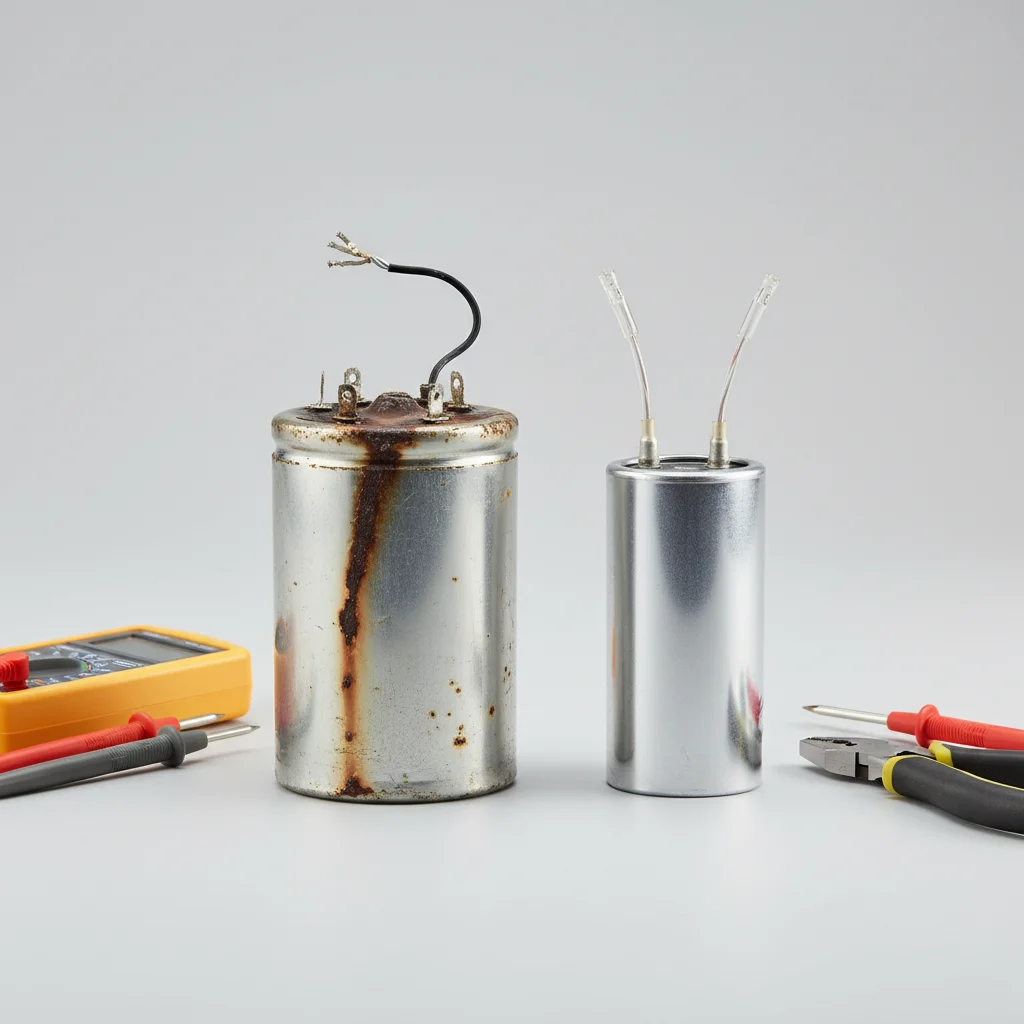
When your air conditioner capacitor isn’t working, it can prevent your AC unit from starting or running efficiently. This critical component provides the initial electrical boost needed to start the compressor and fan motors, and also helps maintain a steady current during operation. A failing capacitor is a common issue, and understanding its symptoms and potential fixes can save you from a complete system breakdown. There are typically three main types of capacitors found in AC units: start capacitors, run capacitors, and dual run capacitors, each serving a specific role in the system’s electrical circuit.
Understanding the Role of an AC Capacitor
The capacitor in your air conditioner acts like a small battery, storing and releasing electrical energy to give the motors the necessary jolt to begin spinning. Without this initial surge, the motors may hum but fail to start, or they might struggle to maintain their speed. A start capacitor provides a large burst of power for a very short duration to get the compressor motor going, while a run capacitor provides continuous power to keep the motor running smoothly and efficiently. Dual run capacitors combine both functions into a single unit, often found in modern AC systems to power both the compressor and the outdoor fan motor.
Over time, capacitors can degrade due to heat, age, or power surges. When a capacitor begins to fail, it can manifest in several ways, from a complete lack of operation to intermittent starting issues. Identifying the type of capacitor and its specific function is crucial for proper diagnosis and replacement.
Symptoms of a Failing AC Capacitor
Recognizing the signs of a failing capacitor can help you address the problem before it escalates. One of the most common symptoms is the outdoor unit (condenser) failing to start, even though the thermostat is set to cool. You might hear a humming sound coming from the outdoor unit, indicating that the motor is receiving power but lacks the necessary boost to begin rotation. Another sign is the fan motor starting but the compressor not engaging, leading to the unit blowing air that isn’t cold. Intermittent operation, where the AC unit cycles on and off frequently, can also point to a weak capacitor that struggles to maintain consistent power.
- Outdoor unit hums but doesn’t start.
- Fan motor runs, but no cold air is produced.
- AC unit cycles on and off frequently.
- Unit struggles to start, especially on hot days.
- Burning smell or bulging capacitor (visible inspection).
Diagnosing a Faulty Capacitor
|
Our Picks for the Best Air Conditioner in 2026
As an Amazon Associate I earn from qualifying purchases.
|
||
| Num | Product | Action |
|---|---|---|
| 1 | Windowless Portable Air Conditioners with Remote, Ventless Ac Unit Ductless Air Cooler,Hoseless Quiet Evaporative Oscillating Swamp Cooler,12H Timer & 4 Ice Box for Room Indoor Outdoor Office Bedroom |

|
| 2 | Evaporative Air Cooler with Remote & Timer, 2200+ CFM Portable Fan That Blows Cold Air for Large Room, Home Office, Bedroom - 2.1Gal High-Capacity Tank, 3 Modes, Whisper Quiet 30dB & Sleep Mode |
|
| 3 | SereneLife Portable Swamp Cooler Air Conditioner - 2500 CFM Airflow, 8 Gallon Water Tank Portable Evaporative Air Cooler for Room & Outdoors, WiFi, Humidifier & Fan Modes, Ice Packs & Remote Included |
|
| 4 | Dreo Tower Fan for Bedroom, 42 Inch 120° Oscillating Fan, 25dB Quiet DC Motor, 28ft/s Velocity Bladeless Standing Fan with 12 Speeds, 4 Modes, 12H Timer Cooling Fans for Home, Living Room |
|
| 5 | Midea 5,000 BTU EasyCool Small Window Air Conditioner - Cool up to 150 Sq. Ft. with Easy-to-Use Mechanical Controls and Reusable Filter, Perfect for Small Bedroom, Living Room, Home Office |
|
| 6 | Portable Air Conditioners, 3-IN-1 Swamp Cooler, Evaporative Air Cooler,Remote & Touch Control, 90°+90° Oscillation,LED Screen, Air Coolong Fan for Outdoor Indoor |
|
| 7 | Dreo Tower Fan for Bedroom, 2026 Upgraded DC Motor, 28ft/s High Velocity, 20dB Ultra Quiet Standing Fan, 8 Speeds 4 Modes, 90° Oscillating Bladeless Fan for Indoors, Floor Fans with Remote, Black |
|
| 8 | 24" Windowless Portable Air Conditioner, 15H Timer & 120°Oscillation, 3-IN-1 Portable AC Unit with Remote, 2-Gal Tank, 3 Modes & 3 Speeds, Ultra-Quiet Ventless Swamp Cooler for Home Office, Off |
|
| 9 | Windowless Portable Air Conditioner, 24.4" Small Evaporative Air Cooler for Room No Window, 3-Speed Settings, 4 Modes, 7H Timer, Remote Control, 4 Ice Packs, Quiet AC Unit for Bedroom, White |
|
| 10 | BLACK+DECKER Window Air Conditioner 10000 BTU, AC Window Unit Cools Up to 450 Square Feet, Window AC Unit with Remote Control, 3 Cooling Speeds and Fan Only Function, BD10WT6, White |
|
Diagnosing a faulty capacitor typically involves a visual inspection and testing with a multimeter. Before attempting any inspection or testing, always ensure the power to your AC unit is completely shut off at the breaker to prevent electrical shock. Visually inspect the capacitor for any signs of damage, such as bulging, leaking fluid, or burn marks. A healthy capacitor should appear smooth and intact. If there are no visible signs of damage, a multimeter with a capacitance setting can be used to test its microfarad (µF) rating against the specifications printed on the capacitor itself. A reading significantly lower than the specified range indicates a failing capacitor.
Replacing a Faulty Capacitor
Replacing a faulty capacitor is a relatively straightforward process for those comfortable with basic electrical work, but it’s crucial to prioritize safety. After ensuring the power is off and discharging the capacitor (using an insulated screwdriver to short the terminals), carefully note the wiring connections. Take a picture if necessary. Disconnect the old capacitor and connect the new one, ensuring the correct terminals are used for the fan, compressor, and common connections. Always use a replacement capacitor with the exact same microfarad (µF) rating and voltage rating as the original. Using an incorrect capacitor can lead to further damage to your AC system. If you are unsure about any step, it is always best to consult with a qualified HVAC technician.
For reliable replacement parts, consider checking options like thewhich offers a range of compatible capacitors for various AC models. Proper installation is key to ensuring your AC unit operates efficiently and safely after the replacement.
Preventative Measures and Professional Help
While capacitors are wear-and-tear components, some preventative measures can help extend their lifespan. Ensuring your AC unit is regularly maintained, including cleaning coils and filters, can reduce the overall strain on the system, which in turn can lessen the stress on electrical components like the capacitor. Avoiding frequent short cycling of your AC unit can also help, as each start-up puts a significant load on the capacitor. If you’re experiencing recurring capacitor failures or are uncomfortable performing the replacement yourself, it’s always advisable to contact a professional HVAC technician. They can accurately diagnose the issue, ensure proper installation, and check for any underlying problems that might be contributing to capacitor failure. For professional service, consider contacting local HVAC experts through services liketo find certified technicians in your area.
Get our weekly buyer guide
Practical specs, not advice. Unsubscribe anytime.
